
Readability Analyzer - How to Check and Improve Your Text Readability Score
Writing clearly is one of the hardest skills to develop, and one of the most valuable. Whether you are writing a blog post, an academic essay, a product description, or an email, the way your text reads determines whether people finish it or click away. A readability analyzer gives you objective data about how your writing performs — and exactly what to fix.
What Is a Readability Score?
A readability score is a number that estimates how easy a piece of text is to read and understand. The most widely used formula is the Flesch Reading Ease score, developed by Rudolf Flesch in 1948. It produces a score from 0 to 100 based on two key measurements: how long your sentences are on average, and how many syllables your words contain on average.
The higher the score, the easier the text is to read:
- 90-100: Very Easy — anyone can read this, including young children
- 70-90: Easy to Fairly Easy — comfortable for most adults
- 60-70: Standard — the level most online content targets
- 50-60: Fairly Difficult — college student level
- 0-50: Difficult to Very Difficult — academic or specialist writing
The Flesch-Kincaid Grade Level
Alongside the Flesch Reading Ease score, our analyzer also calculates the Flesch-Kincaid Grade Level. This converts the same underlying measurements into a US school grade equivalent. A grade level of 8 means the text is readable by an average 8th grader. Most popular websites and major newspapers write at a grade 6-8 level, not because their readers are uneducated, but because lower grade levels are simply faster and easier to process for everyone.
The formula was originally developed for the United States Navy to evaluate training manuals. It is now one of the most widely used readability tests in the world, used by educators, publishers, and content teams to ensure their writing reaches its intended audience.
Why Sentence Length Matters So Much
One of the strongest predictors of readable writing is sentence length. Long sentences force readers to hold more information in working memory while parsing meaning. Every time a sentence crosses 25 words, the cognitive load increases noticeably.
Compare these two versions of the same content:
Long version: "The analysis of user engagement data that was collected over the previous quarter suggests that visitors to our website who arrive through organic search channels tend to spend significantly more time on product pages than those who arrive through paid advertising campaigns."
Short version: "Users who arrive through organic search spend more time on product pages than paid ad visitors. This trend appears consistently across last quarter's data."
Same information. The short version is faster, clearer, and more memorable. Our tool flags every sentence longer than 25 words so you can decide which ones to split.
Passive Voice and Why It Weakens Writing
Passive voice is when the subject of a sentence receives the action instead of performing it. "The report was written by the team" is passive. "The team wrote the report" is active. Active sentences are shorter, clearer, and more direct. Passive constructions add words without adding meaning and often obscure who is responsible for an action.
That said, passive voice is not always wrong. In scientific writing, it is often used intentionally to maintain an objective tone. The key is awareness — knowing when you are using it and choosing it deliberately rather than as a habit.
Our analyzer detects passive patterns automatically and lists every sentence that uses them so you can review each one individually.
Understanding Keyword Density for SEO
Keyword density measures how often a specific word appears in your content as a percentage of the total word count. For SEO, this matters because search engines use word frequency as one signal to understand what a page is about.
The general guideline is:
- Under 1%: The keyword may not be prominent enough for search engines to recognize it as a topic signal
- 1-2%: Ideal range — natural-sounding and strong enough to signal relevance
- Over 3%: Risk of keyword stuffing, which can result in search engine penalties
What Complex Words and Adverbs Tell You
Complex words are defined as words with three or more syllables. A high percentage of complex words makes text harder to read regardless of sentence length. Technical subjects sometimes require specific terminology, but whenever a simpler word exists, it is almost always the better choice.
Adverbs ending in "-ly" are a common sign of weak writing. Instead of writing "ran quickly," stronger writing says "sprinted." Instead of "very important," say "critical." The presence of many adverbs often indicates that the underlying verbs and adjectives are not strong enough. Our tool counts adverbs so you can evaluate whether they are adding value or padding.
How to Use This Tool
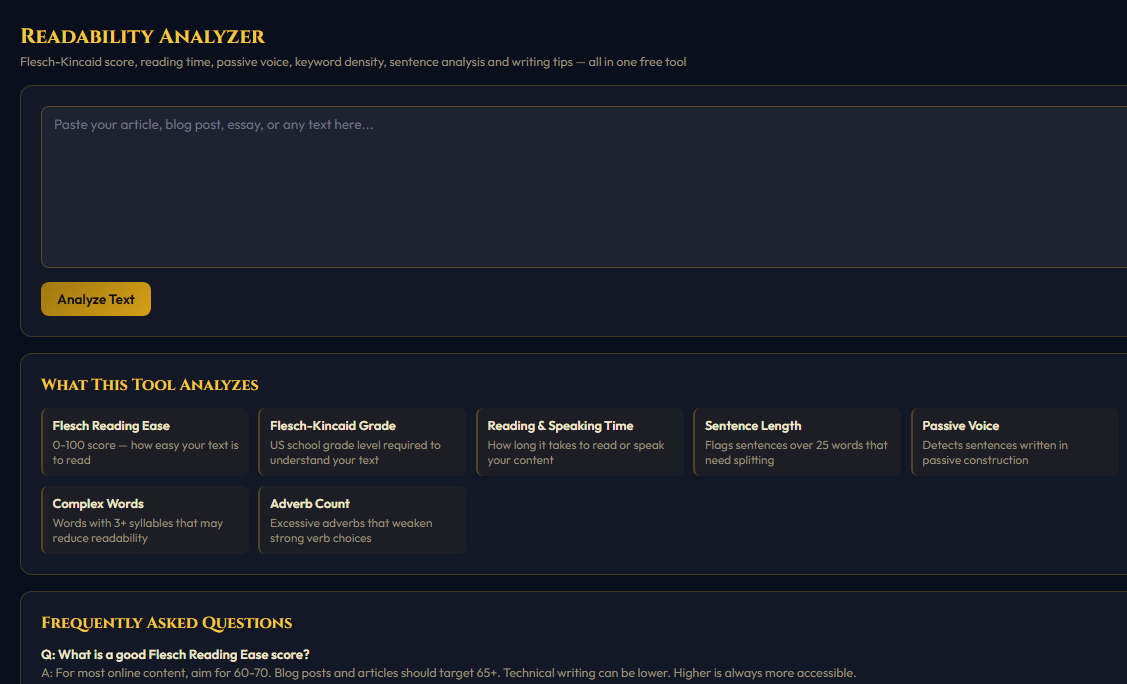
Paste any text into the input area and click Analyze. The tool immediately produces:
- A Flesch Reading Ease score with a colored progress bar
- A Flesch-Kincaid Grade Level
- Estimated reading and speaking time
- Full stats: word count, sentence count, paragraph count, characters, average sentence length, average syllables per word
- A list of long sentences (Sentences tab)
- A list of passive voice sentences (Sentences tab)
- Top keyword density chart (Keywords tab)
- Personalized improvement tips with pass, warn, and fail indicators (Tips tab)
Who Should Use a Readability Analyzer
Bloggers and content writers use readability scores to ensure articles are accessible to a broad audience and perform well in search results, since Google has confirmed readability is a factor in rankings.
Students and academics use it to check essays meet assignment requirements for clarity and grade level, or to simplify writing before submission.
Marketers and copywriters use it to ensure product descriptions, landing pages, and email campaigns communicate clearly and convert effectively.
SEO professionals use keyword density data to check that target keywords appear with the right frequency throughout a piece of content.
Non-native English writers use it to identify sentences that may be grammatically correct but are harder than necessary to understand.
Try It Free
Use our Readability Analyzer to check your writing instantly — Flesch score, grade level, passive voice detection, keyword density, sentence flags, and personalized improvement tips, all in one place and entirely free.